Introduction
Aim: You will learn how to return to earth where you want, safely, with a glider that can be flown again.
What do we know?
When does a flight stop?
What stages are there to a landing?
Recap: The Approach
What is it?
What is its purpose?
Where does it put you?
What speed will you be travelling at?
Elements of a Landing
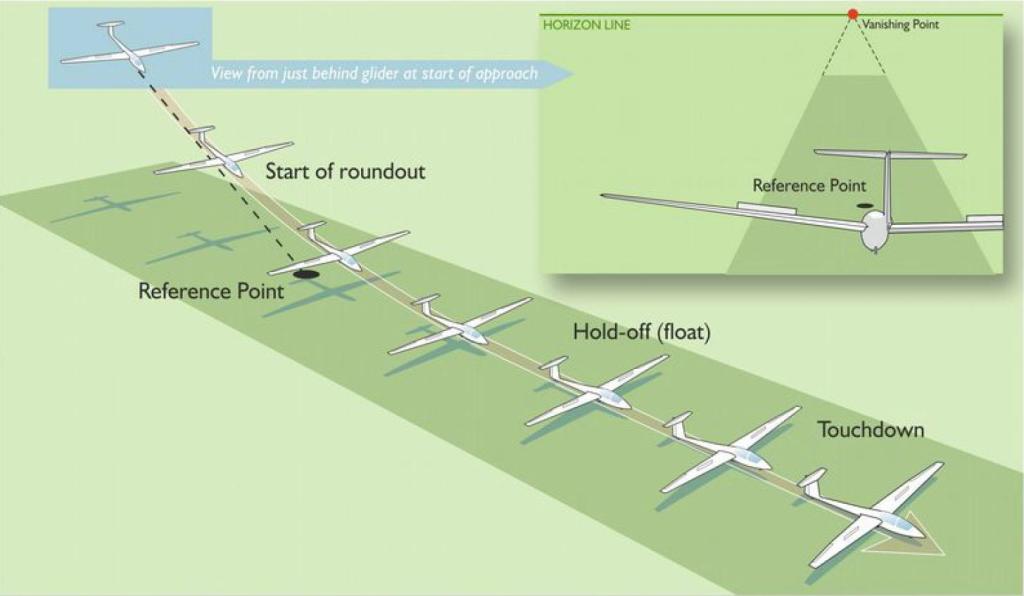
Video: A normal landing
Round-out
The perspective changes:
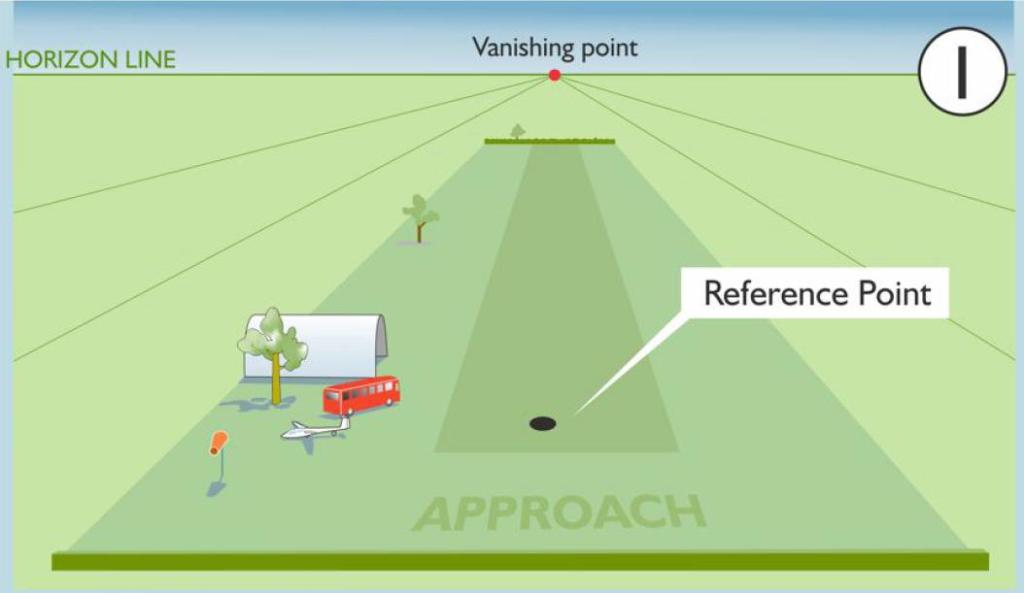
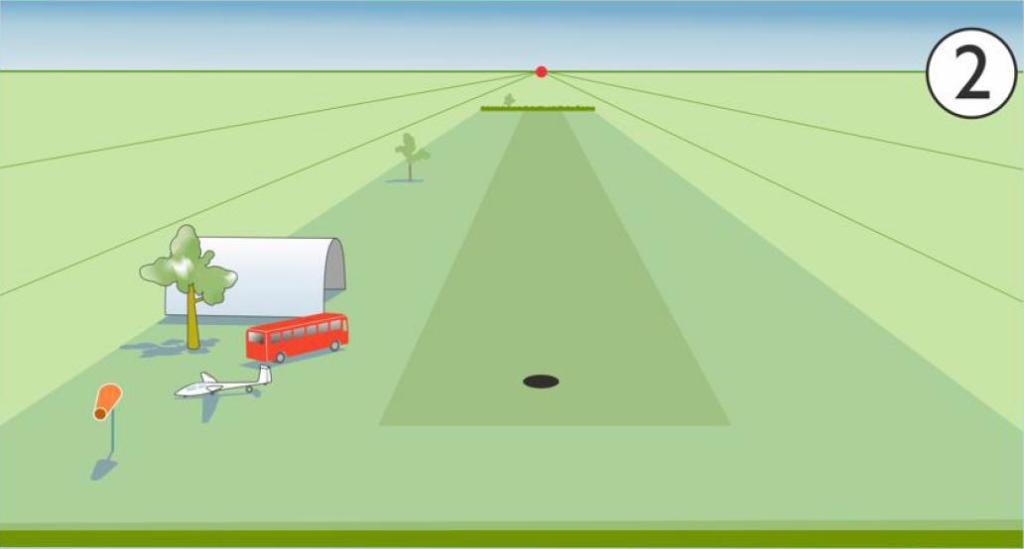
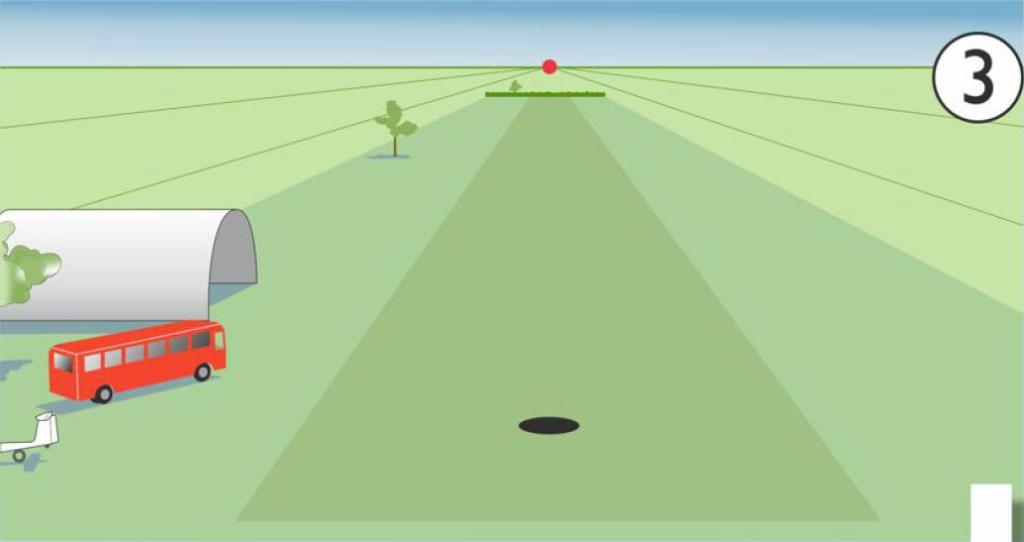
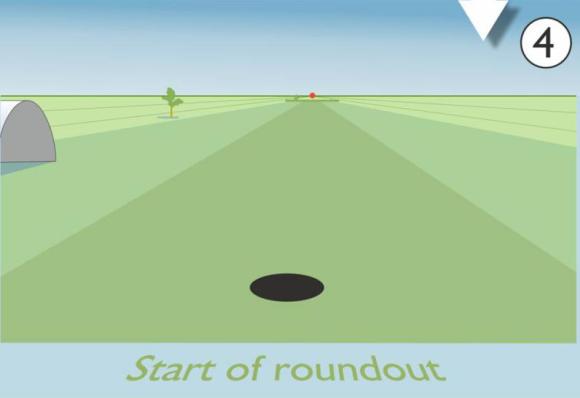
Purpose: round-out to avoid hitting the RP
Method:
- At about tree-top height, ease the stick back gently, to achieve a float just above the ground.
- Move your focus to the vanishing point, ahead.
- Use peripheral vision to judge the rate of round-out.
- Keep the airbrakes constant throughout.
Float (or Hold-Off)
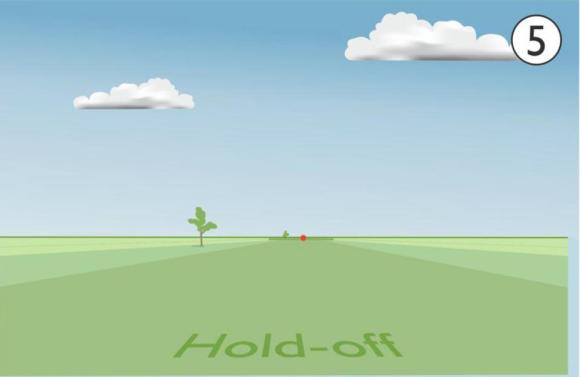
Purpose: to hold the glider airborne, just above the ground
Method:
- Progressively ease the stick back (it may become heavy)
- Maintain the same height above the ground (peripheral vision)
- Keep the airbrake setting constant
- Focus remains on the vanishing point
- Allow the glider to gently stall on (probably very soon after tail wheel has contacted the ground, with the main wheel only a few inches above the ground). The ‘fully held-off landing’.
- Stay focused for the ground run.
Ground-Run
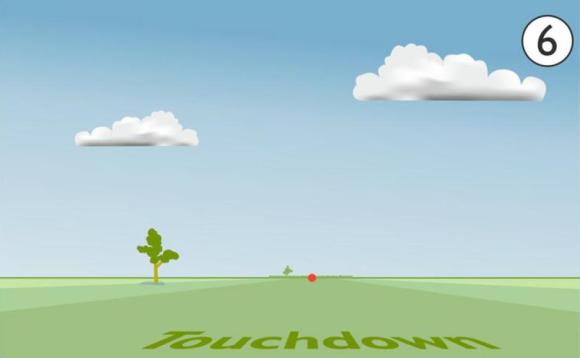
Purpose: bring the glider to a safe stop
Method:
- Open airbrakes further (caution: opening fully may activate the wheel brake)
- Keep, or bring, the stick fully back
- Wings level (ailerons)
- Directional control (rudder)
- Larger control movements needed as the ground speed decays
- If using the wheel brake:
- Apply gently: risk of ground-loop
Difficulties Arising
Round-out too high
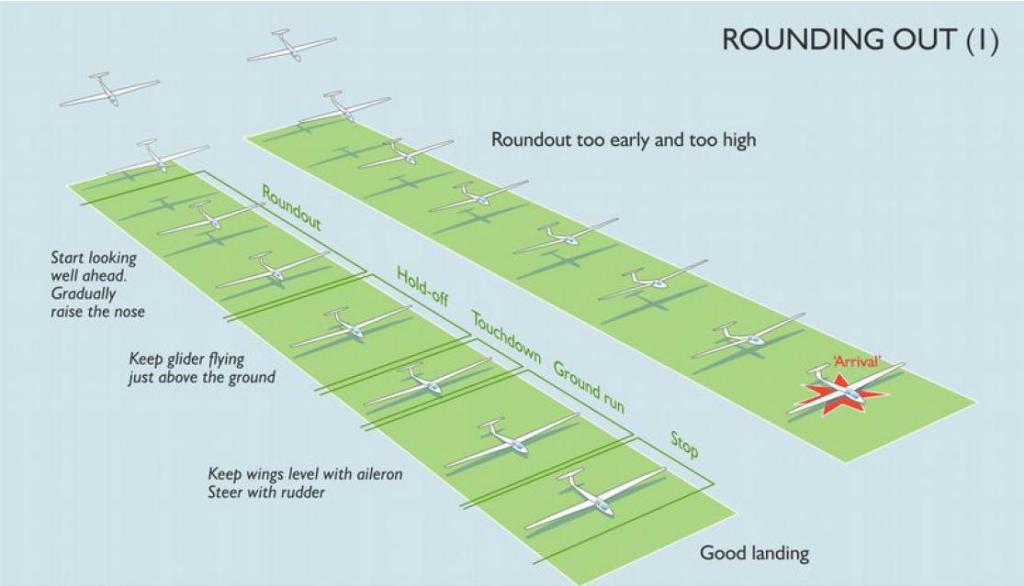
Problem:
- If the float is too high, there is a danger of dropping too far.
Action:
- If speed is safe and attitude is level, with moderate airbrake setting: hold everything.
- If speed is safe and attitude is level, with a large airbrake setting: ease the airbrakes in.
- If speed is slow and/or attitude is nose-up, with airbrakes open: close the airbrakes and gently lower the nose.
Round-out too late
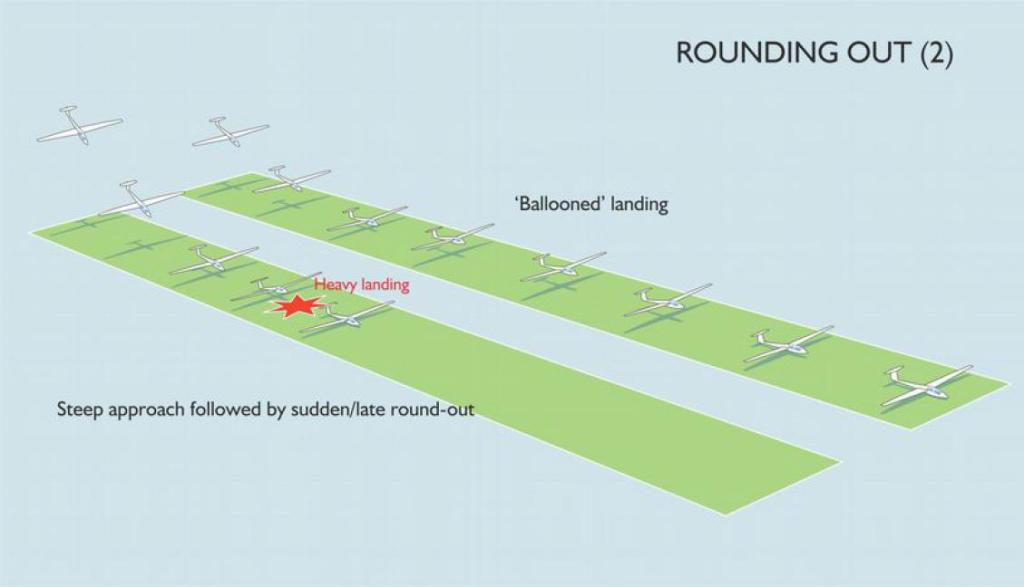
Problem:
- A hard impact will follow, very quickly.
Solution:
- It’s a question of developing the judgement. Good round-outs are often preceded by looking well ahead, early.
Ballooned Landing
Problem:
- A little too much stick back movement causes the glider to rise: the ground has fallen away.
- The glider is now higher, and slower.
Action:
- Correct the attitude: level, promptly, smoothly.
Ground Loops
Causes
- Intentional
- Short field / out of room / collision avoidance
- Can only land ahead
- Accidental
- Tail heavy glider
- Out of balance on landing
- Wheel brake on at touchdown (especially on wet grass) – beware gliders with wheel brake linked to full airbrake setting
- Tall grass / crop
Recovery
- Stick forward, fully, immediately
- Out of turn aileron
- Out of turn rudder
Intentional Ground Loop
You might break the glider – get it inspected – but you’re very unlikely to break yourself. Sometimes it is the best option.
- Stick forward
- Into turn aileron, to get the wing down
- Out of turn rudder to mitigate the rotation
Landing in a Crosswind
Video: Landing in a crosswind
Crabbing or Wing Down (Sideslip)?
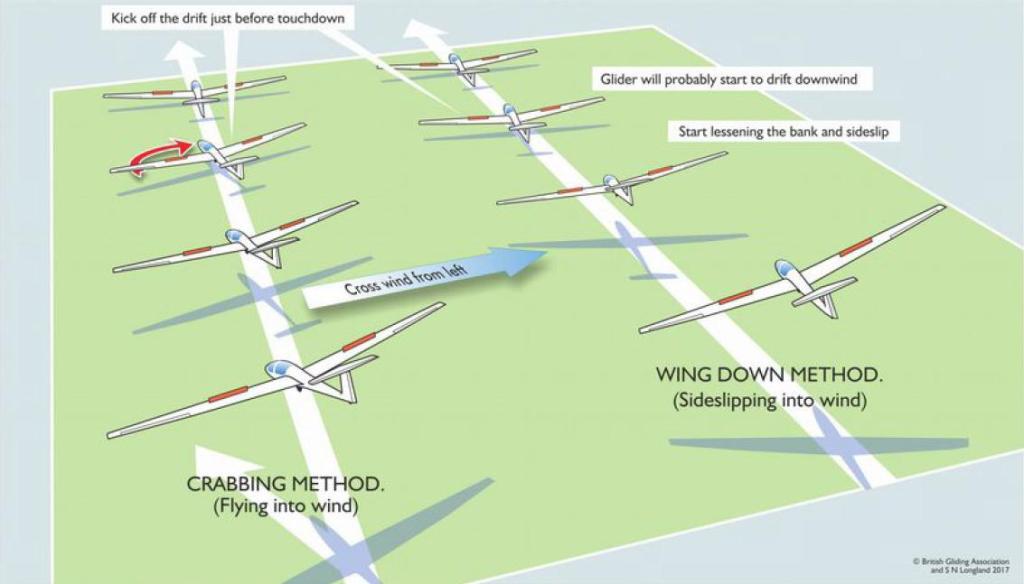
Crabbing
- Wings level in flight
- Yaw into wind, to drift along the intended track
- Kick off the yaw immediately before touch-down
- Into-wind wing low during the ground run
- When stopped, use aileron to put the into-wind wing on the ground.
Wing Down (Sideslip)
- Approach in line with landing path
- Sideslip (bank and opposite rudder) to track in line with landing path
- Reduce bank immediately before touch-down
- Into-wind wing held low during the ground run
- When stopped, use aileron to put the into-wind wing on the ground
- Advantage: well suited to landing cross-slope when the wind is blowing up the slope – in which case landing into wind would be down-hill.
Landing Uphill & Downhill
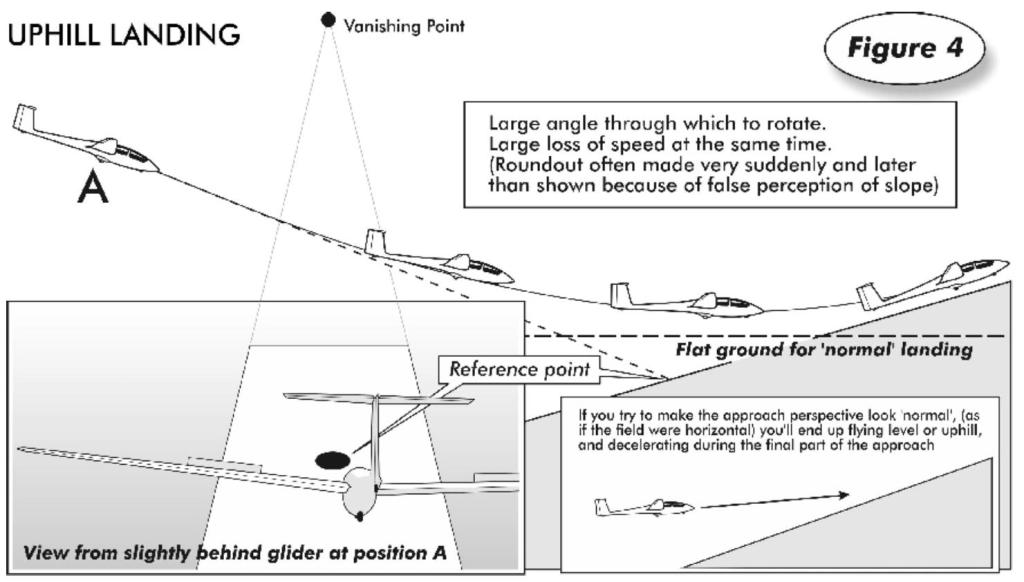
- Landing up or down-slope changes the perspective
- Maintain the correct descent path by monitoring the ASI
- Uphill landings require additional approach speed
- Downhill landings are undesirable.
Recap
- What is the purpose of the Reference Point?
- Where is your focus after passing the RP?
- What is the ideal stick position at the point of touch down?
- When does the flight stop?
- In a crosswind, what action is performed immediately before touch down?
TEM
Threats
Unexpected Student Pilot action
Mitigation:
- Instructor should avoid unnecessary prompting.
- Instructor rake control early when required.
Errors
Lots of potential Student Pilot errors.
Mitigation:
- Instructor guards the controls effectively.
- Instructor take control early when required.
Impacting the ground, hard.
Mitigation:
- Look well ahead just before the round-out
- Round-out progressively.
Collision with objects on the ground.
Mitigation:
- Don’t point at anything you don’t want to hit.
- Avoid congested landing areas.
Wing drop and ground loops.
Mitigation:
- Look well ahead just before the round-out, and throughout the ground run, to detect small deviations in angle of bank and direction.
Flight exercises
Landing should be taught in isolation from Approach Control.
Landing Demonstration
Instructor flies the glider from early in the approach. Patter through the approach e.g.
- Alignment, attitude, airspeed, RP, all good…
- Continuing towards the RP…
- Approaching the flare…
- Looking up/ahead now. Flaring now…
- Smooth round-out, maintaining this height, nose rising to this attitude…
- In a cross-wind: Rudder to point the glider (in the intended landing direction), keep wings level with aileron.
- Touchdown – keep the stick coming back, full airbrake, steer with rudder, wings level with aileron.
Student attempts
Instructor allows student to land the glider. Early attempts may require prompts per the patter.
Otherwise guard the controls. If in doubt, take control immediately.
Ballooned Flare / Landing
To set up use:
- a low airbrake setting,
- speed about 10kts higher than normal,
- normal stick input to round out.
- Be ready to take control during student’s attempt to recover.
 glidingschool.com