Introduction
Aim: You will be able to roll the glider quickly, efficiently and safely
What do we know?
- What steps do we take when rolling the glider?
- When will we want to ‘turn’ instead of roll?
- What’s different about turning, compared to rolling?
Turning is different because…
It involves a higher angle of bank,…
…which changes the dynamics involved.
Increased risk of spins, and these are potentially near the ground, or in close proximity to other gliders.
Theory
Refer to RJPLancaster.net for the full lectures on the principles of glider flight (and instruments).
Short version, relating to turns:
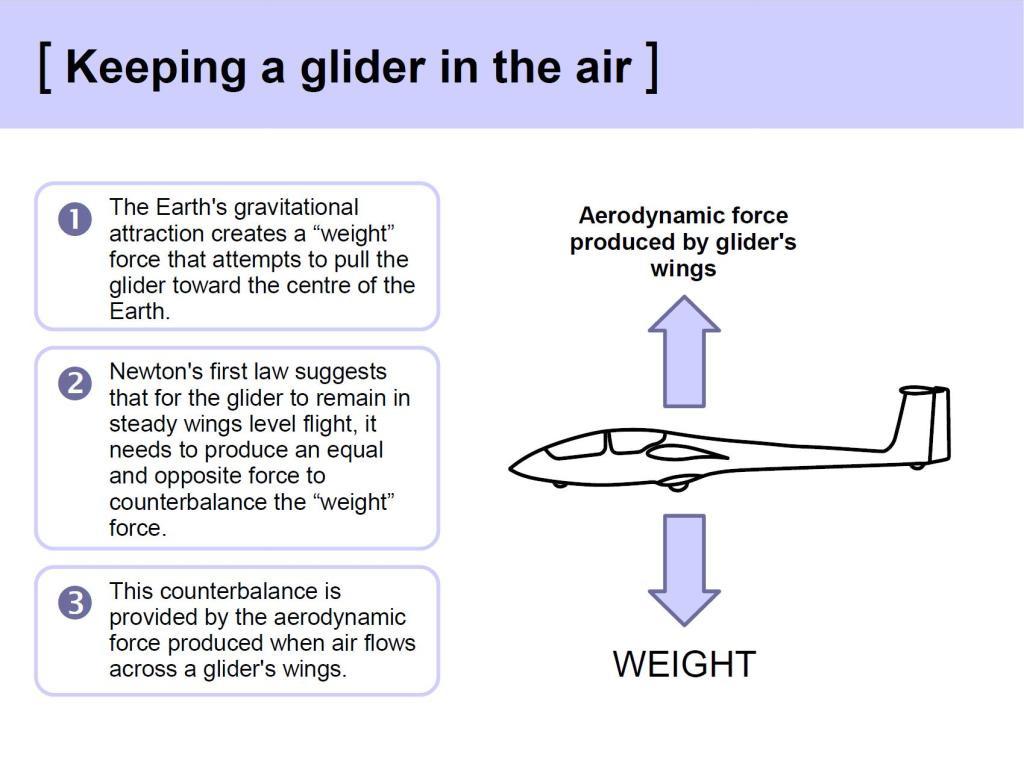
Forces in level flight
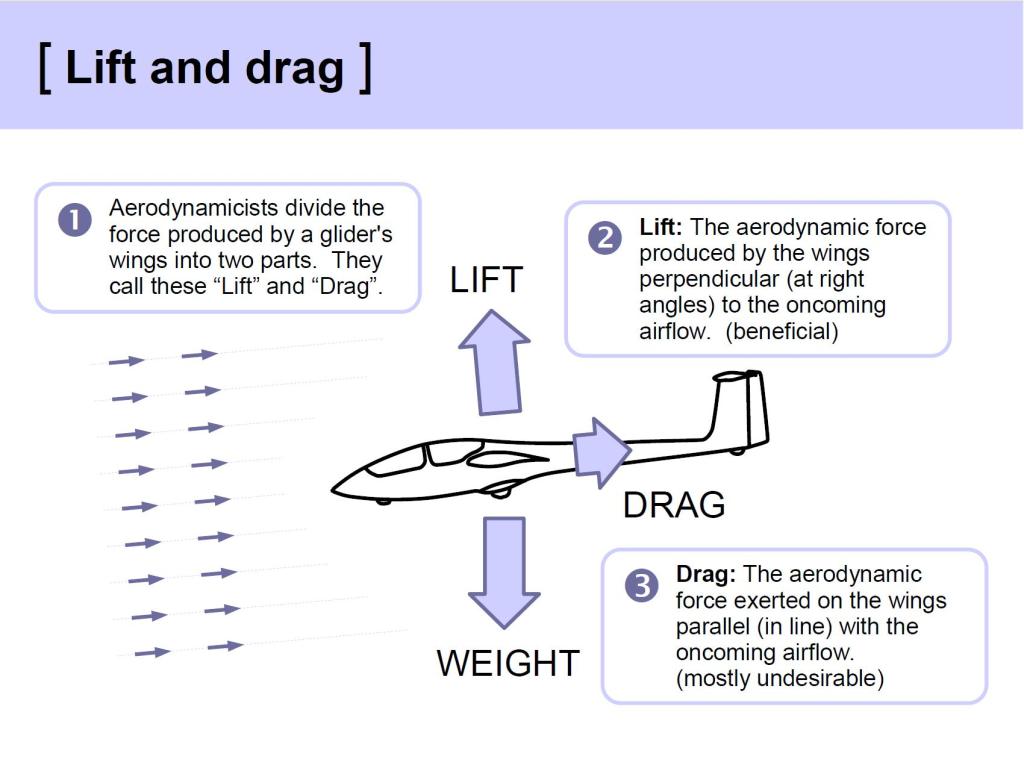
Lift supports weight, and acts perpendicular to the airflow.
Forces in a turn
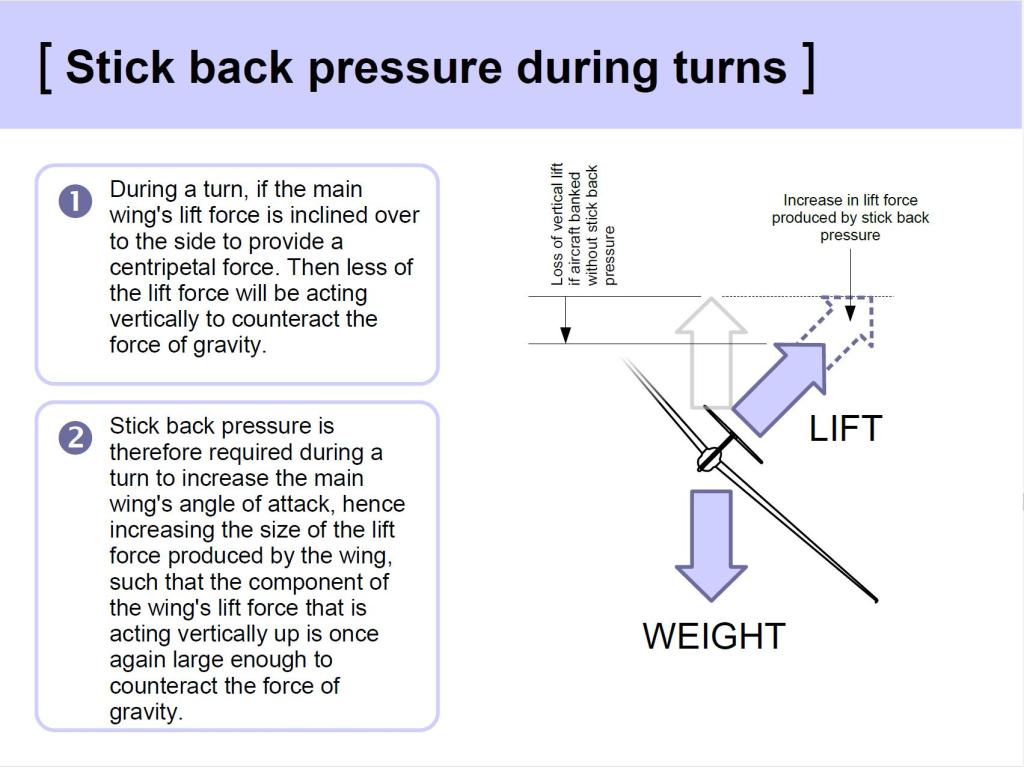
Lift is perpendicular to the wings as viewed from the front.
When banked:
- Lift is acting sideways as well as vertically, reducing the vertical component.
- Hence, more lift is required, to generate the additional vertical lift needed to match the weight.
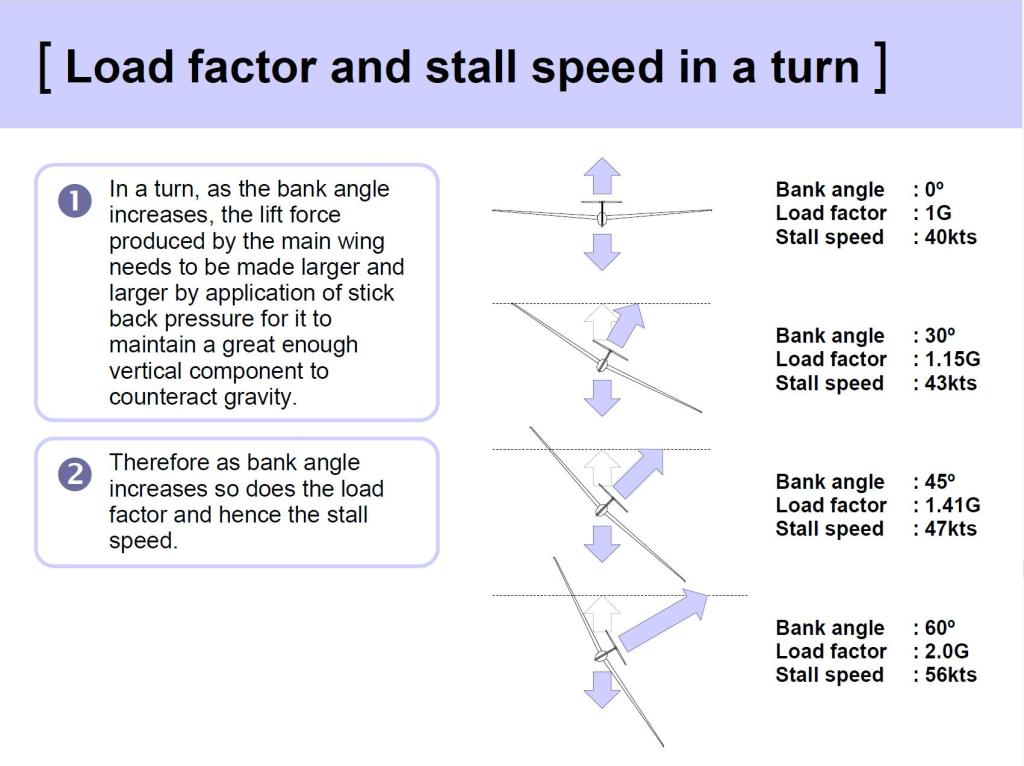
As the angle of bank increases, so does the need for even more lift.
Stall speed increases in a turn
Increasing the lift will increase the Load (or G, which acts opposite to lift).
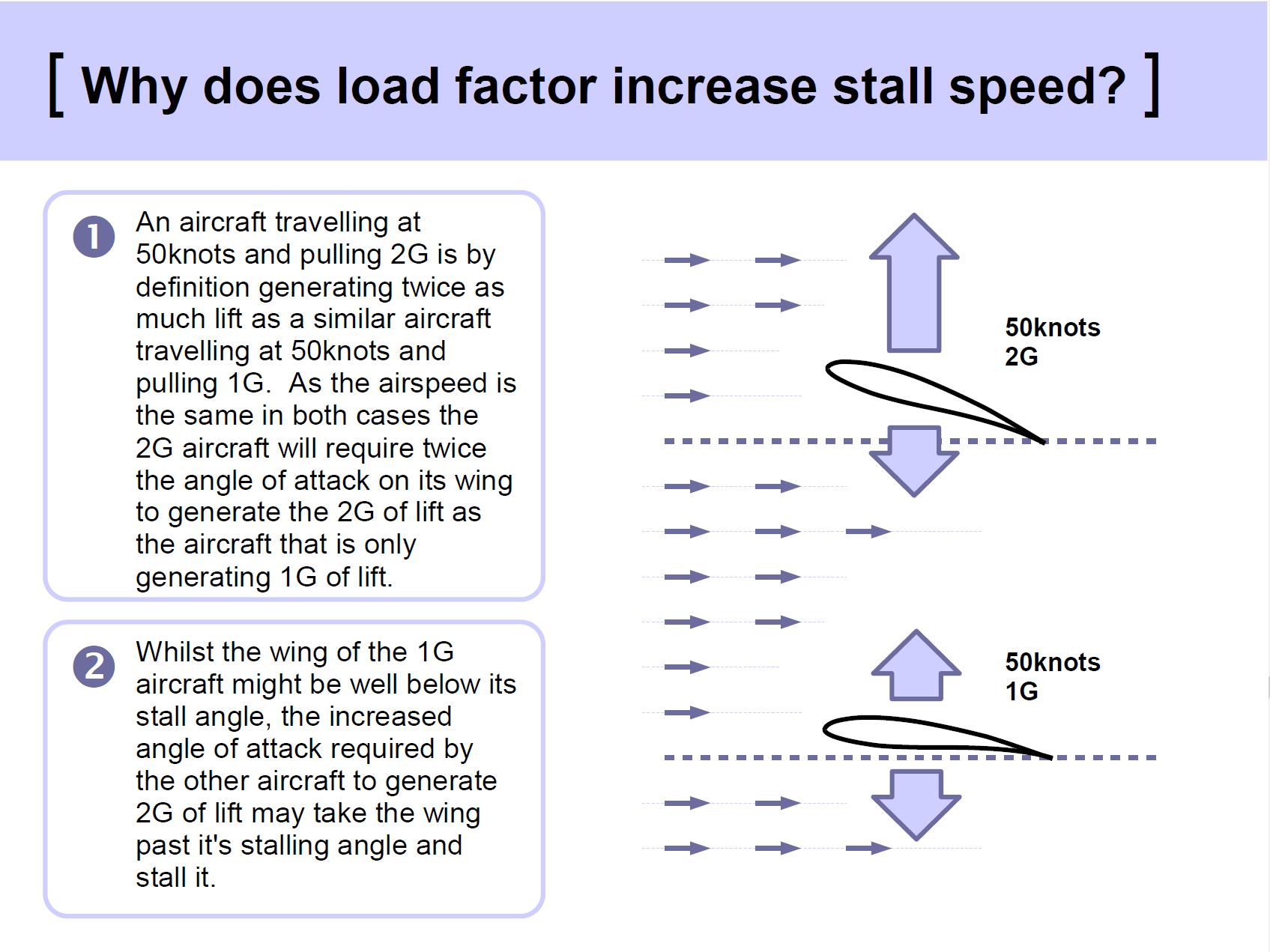
To increase the Lift at any given speed, we must increase the Angle of Attack, potentially nearing or passing the Critical AoA, at which the wing will stall.
If the AoA is already close to the Critical angle, we can can only increase Lift by increasing Speed.
More detail? Iso-Gs
In a nutshell, steeper turns generate more G, increasing the Stall Speed:
Fly faster in steeper turns.
| Bank Angle | G Load | Stalling Speed |
|---|---|---|
| 0° | 1G | 40kts |
| 30° | 1.15G | 43kts |
| 40° | 1.41G | 47kts |
| 60° | 2G | 56kts |
Video: Five minutes of stalling in steep turns where two will do.
Changing effects and usage of controls
The impact on Pitch, Roll and Yaw when using the Elevator, Aileron and Rudder:
Elevator
Controls Pitch. When steeply banked it also:
- increases the rate of turn
- increases the load
- increases the stall speed
Usage: Control the pitch (and speed). In steeper turns, over 45 degrees, the elevator does not raise the nose much or at all – roll out before adjusting pitch.
Ailerons
Controls the rate of Roll. When banked the outer wing
- is flying faster
- generates more lift than the inner wing.
Usage: Roll in, centralise the stick to stop the bank increasing – but you may then need some ‘out of turn’ stick to hold the desired bank angle.
Rudder
Controls Yaw. When in a well banked turn, it also raises and lowers the nose, causing slips and skids.
Usage: Coordinate with aileron to keep the string central.
Slips and Skids
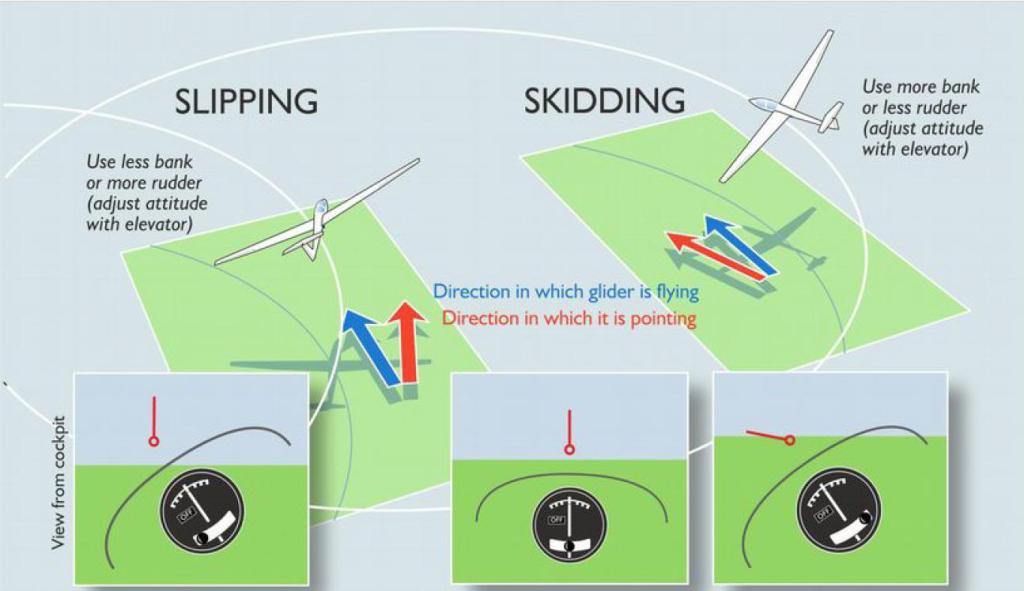
Note: When powered off, the Turn & Slip indicator:
- Needle does not work
- Ball always works – “kick the ball”
- The string always works (unless wet)
Over-Ruddered Turns
Why is over-ruddering tempting, but dangerous?
- Over-ruddering causes the nose to drop, which looks safe, but…
- The inner wing has slowed down, so will be nearer the stall.
- The temptation, to be avoided, is to raise the nose with the elevator…
- as it could stall the inner wing, causing a Spin.
Aileron and rudder should always be used in a coordinated manner, keeping the string central.
Making a Turn
Going In
A brief transitory phase
First action: Lookout! Where?
Then look over the nose, to monitor:
- Attitude
- Roll rate
- Bank
- Yaw String
Coordinated use of aileron, rudder and elevator, using an equal movement, or pressure:
- Aileron: Rate of Roll
- More aileron makes it faster, and requires more rudder.
- Rudder: To overcome Adverse Yaw
- Keep the nose pointing into the airflow (String straight back)
- Proportional use
- Elevator: To control Pitch
- Increasing back pressure
Staying In (and correcting Slip and Skid)
- Aileron: Hold the bank angle
- Neutral stick position
- Possibly a little ‘out of turn’
- Rudder: No aileron drag in this phase
- Less rudder required
- Monitor the Yaw String (or Ball)
- Elevator: Maintain Pitch
- Track the horizon (assuming it is flat!)
- Corrections: Adjust Bank, then Pitch
- Trim: if staying in – e.g. Thermals
- Lookout and Scan Cycle in the turn
- Where are the threats?
- Thermal Turns
- In Circuit & Final Turns
- Where are the threats?
Coming Out (onto a Heading)
Also a brief transitory phase
First action: Lookout! Why? Where?
Then look over the nose, to monitor:
- Attitude
- Roll rate
- Bank
- Yaw String
Approximately 30-40 degrees early, commence roll out.
Coordinated use of aileron, rudder and elevator:
- Aileron and Rudder: centralise as wings come level
- Elevator: reduce back pressure
- Trim
Coming out on a heading takes a little practise:
- Start by commencing the roll out when pointing at a reference, and see how far you have turned when the wings are level.
Video: Turning
Recap
- What happens to the stall speed in steeper turns?
- Why?
- What is the first action when turning?
- What is next?
- Why is an over-ruddered turn dangerous?
- How do you prevent an over-ruddered turn?
- How do you exit on a heading?
TEM
Threats
Collision
Mitigation:
- Maintain a thorough lookout.
Errors
Running out of height for an appropriate circuit.
Mitigation:
- Monitor height and position.
Stall / Spin.
Mitigation:
- Coordinated use of the controls, to keep the string straight.
Flight Exercises (Turning)
A great deal of practise is required to become skilled at turning. Ever present is the need to remind the student pilot to:
- Lookout
- Look over the nose, to monitor & control:
- Attitude (and therefore speed)
- Direction and Rate of Yaw
- Direction and Rate of Roll
- Bank angle
- (String) Slip & Skid
Staying In the Turn
- Nose moves steadily around the horizon.
- Angle of bank constant. Correct with coordinated controls.
- Continue to lookout.
Coming Out of the Turn
- Lookout.
- Take off bank using coordinated aileron & rudder.
- Relax back pressure.
- When wings are level, centralise aileron and rudder.
- Re-trim.
Going Into the Turn
- Lookout.
- Look over the nose.
- Roll, using aileron and rudder together.
- Maintain attitude, using back pressure on the stick.
- When the desired angle of bank is achieved, use ailerons to prevent it increasing, reduce rudder.
- Lookout
Recognition and Correction of Slip (under-ruddered)
- Yaw string deflected out of the turn.
- Slip ball deflected into the turn.
- Nose is high.
- Use more into-turn rudder, coordinated with aileron and elevator.
Recognition and Correction of Skid (over-ruddered)
- Demonstrate so student can see what is shappening:
- Yaw string deflected into the turn.
- Slip ball deflected out of the turn.
- Nose is low.
- Reduce into-turn rudder, coordinated with aileron and elevator.
- Extension – why it matters:
- Demo coordinated turn, slowing to buffet.
- Note nose does not drop.
- Demo uncoordinated turn (over-ruddered), slowing to the buffet.
- Wing will drop.
- Punchline: “Always fly at the right speed, fly coordinated.”
- Demo coordinated turn, slowing to buffet.
Varying Angles of Bank
- Practise, while keeping the speed constant.
Varying Rates of Roll
- Practise: roll quickly, retaining coordination.
Turn Reversals
- Practise, retaining coordination with speed constant: develops coordination of all three controls.
Regain a Heading (Ground Feature, Compass Heading)
- Aim to roll onto a specified ground feature.
- Small changes to angle of bank.
- Wings level as the glider comes onto the intended heading.
- Practise to judge rate & timing of roll.
- Continue in straight flight.
- Compass Heading:
- When competent at regaining a heading to a ground feature, brief and demonstrate use of compass.
Flight Exercises (Advanced Turning)
Prerequisites:
- Student has mastered coordination at moderate angles of bank.
- Stalling and Spinning exercises completed (so spin avoidance can be focused on here).
Demonstration of Steep Turn
- Lookout
- Look over the nose
- Roll to 45 degrees bank
- Point out control inputs and positions
- Up elevator force
- Out of turn aileron
- Speed control – sensitivity to pitch
- Recovery from excess speed – reduce angle of bank first.
- Varying rates of roll.
Stall and Spin Avoidance and Recovery
- Whilst turning, allow speed to reduce close to departure, demonstrate stall can be avoided by relaxing the pressure on the stick.
- Demonstrate slip and skid, noting how the slip (nose slightly high, string slightly out of turn, with top rudder applied) is the more comfortable.
Student attempts
- It takes time to develop these skills.
- Allow student to practise each of these skills, so they become competent and safe at thermal turns.
- Increase the angle of bank from 30 degrees upwards.
 glidingschool.com