Let’s look at some badly out of position scenarios. This one is low upwind. What to do?
Learning Points
Consider the Options
If you are too far out of position, then by definition you have reduced your options. The next few exercises explore the limits, not because it is a good idea in the real world, but to approach the airfield differently. Their goal is to allow you to explore whatever options remain available to you.
Field Landing
The area around this airport has very few nice looking fields nearby. In this case, maintain a high level of awareness of where you are in relation to the airfield at all times, and especially as you get low. Stay in the ‘landable cone’ projecting out and above the field. In real life, get to know the local field landing options as well, just in case.
Getting Back to the Airfield
If you are upwind, you can afford to fly a little more slowly, nearer to Min Sink, and let the wind carry you some of the way while you conserve height. You will be traveling downwind, and will cover the ground relatively quickly. Aim straight for the landing area until your options to turn onto a normal circuit open up to allow a turn onto a normal circuit.
Choose the Landing Area and the Position of the Final Turn
As you approach the airfield, decide where to land, and where the Final Turn should be. Remember it should be completed above 300′ (100m). If you can reach the normal base leg then do so. Consider turning 180 degrees from the downwind leg onto the approach, or better still, consider turning in early for a landing upwind in the nearest part of the airfield. Finally, you may have to land downwind. If so, radio ahead if at all possible. No-one on the airfield will be expecting to arrive from upwind, nor will they be able to see you easily.
Scenario and Demonstration
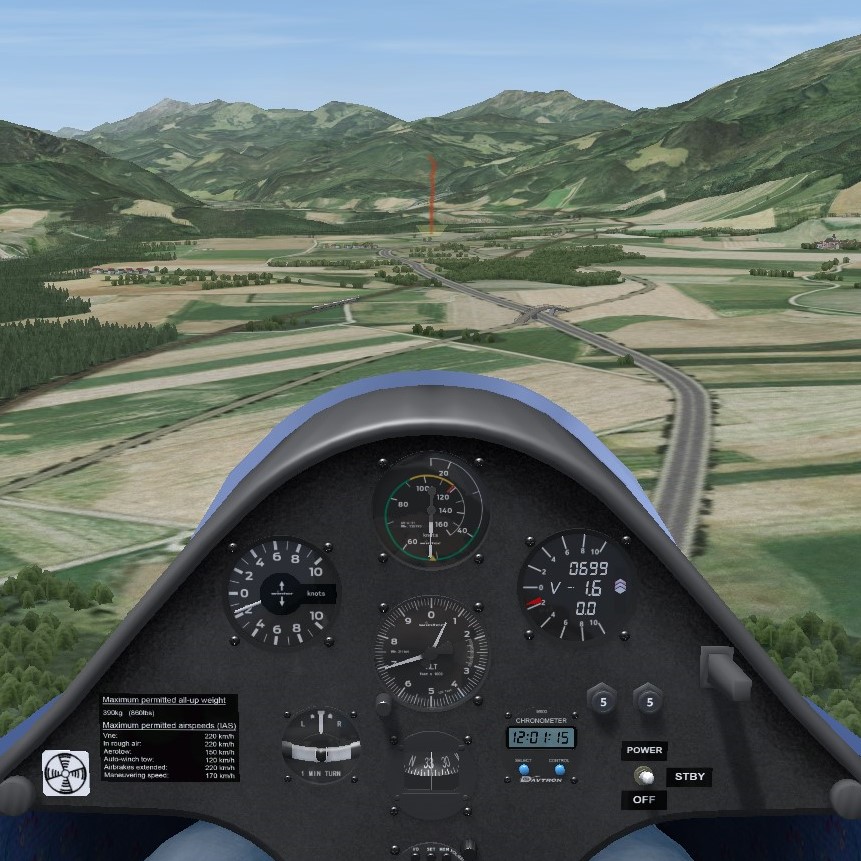
This demonstration shows our pilot low, far upwind. When he turns back, the airfield looks a good way off. He heads straight towards the Low Key area, anticipating an early turn in if it proves necessary. He flies carefully and closer to Min Sink on the downwind leg, conscious he is low and does not want to stall. It is apparent he won’t get all the way to a ‘normal’ low key and turns in early. The pilot makes a short diagonal and a short base leg, to position himself as far downwind as he can whilst maintaining a safe height and speed for a landing on the airfield. His final turn is around 300′ but further upwind than usual, so he uses a fully braked approach, landing into wind, in the normal area, at the upwind end of the field.
About the videos
Multiple versions of the videos are being made available:
- With animation and voiceover.
- Alternative without the animation graphics.
- As recorded in Condor Flight School. These will have messages at the top of the screen, with no additional animation or voiceover – that’s the way the Condor cookie crumbles!
The videos are suited to any device that supports YouTube. If you have trouble loading the video in the browser, click on Watch on YouTube in the lower left corner.
Performing the Exercise
The exercise leaves you in an awkward position, around 700′ QFE, 2km from the field and flying away from it.
Try to make a circuit for an upwind landing from a safe Final Turn.
Afterwards, ask yourself if your legs were as well positioned as you’d like. Were the heights and speeds acceptable? Did you have time to think and adjust all the way round, or were some parts a bit rushed? If you’d do it differently next time, have another go.
Further Reading and References
- Gliding From Passenger to Pilot, 2nd Edition: Page 114-115
- BGA Instructors’ Manual, 4th Edition: Section 3, Chapter 14 Pages 9-10
- BGA Instructors’ Reference Cards: Ex 12b
- Gliding: The British Gliding Association Student Pilot Manual, Section 4.10 and website.
Updates
The GlidingSchool.com lessons were developed for Condor2. They will be updated from time to time. Visit the Downloads page for news of updates, and to request the latest version.
Comments and Feedback
Your comments and feedback would be welcome. Visit the Contact page to send your thoughts.
Forums
Join us on the Forums provided by Condor Soaring and GliderPilot.net (the URAS forum).
 glidingschool.com